Sleeves are the most underrated detail in an abaya. The same fabric, the same length, the same cut — change the sleeve and you’ve changed the entire garment. Yet most buyers never think about sleeves until they spot something they like and can’t describe it. This guide covers the main abaya sleeve styles in plain language: how each one looks, how it fits, and exactly what to say on WhatsApp when you want it made for you.
If you’re still deciding on the overall silhouette, our complete abaya styles guide is the right starting point. This post assumes you’ve chosen the cut and now want to nail the sleeves.
Why Sleeves Matter More Than You Think
Abaya sleeve styles do three jobs at once. They set the formality of the piece — a bell sleeve reads occasion-wear while a straight sleeve reads everyday. They change how the abaya feels to wear, especially during prayer, driving and cooking. And they decide how the abaya flatters your frame, since sleeves are the part of the garment that frames your arms and hands. Get the sleeves right and the whole abaya looks designed; get them wrong and nothing else saves it.
The Main Abaya Sleeve Styles
Straight Sleeves
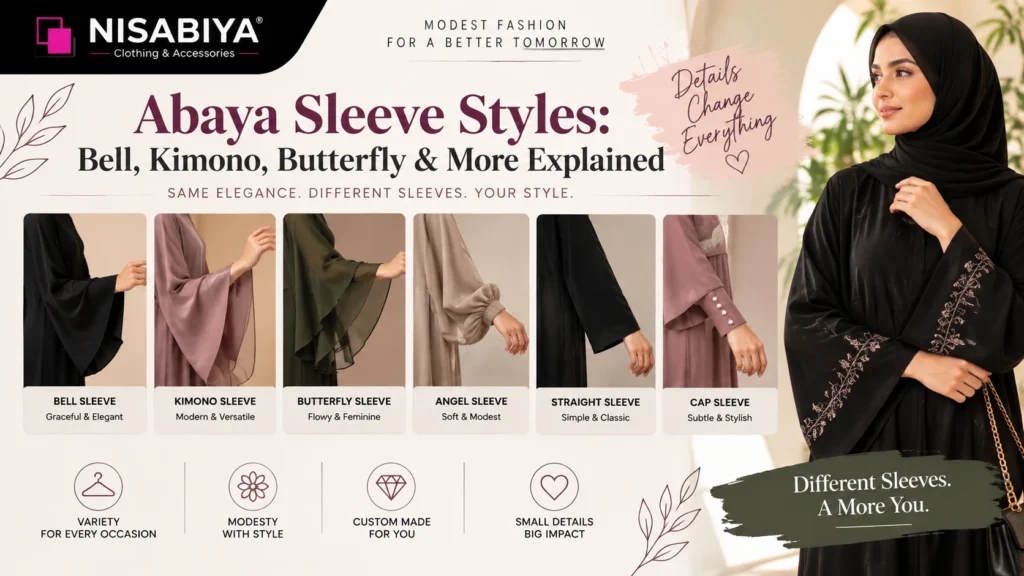
The straight sleeve is the classic, no-fuss option — cut straight from the shoulder to the wrist or hand. It’s the most practical abaya sleeve style for daily wear, prayer and work because it never gets in the way.
- Best for: daily wear, office, school, prayer, anything practical.
- What to check: the bicep opening. A straight sleeve that’s cut too narrow binds when you raise your arms — we add ease here in custom stitching.
Bell Sleeves
Bell sleeves flare out from the elbow or forearm to a wide, graceful opening at the hand. They add movement and femininity to an abaya without the drama of a full kimono, and they’re consistently one of the most requested abaya sleeve styles in our custom orders.
- Best for: Eid, gatherings, and anyone who wants elegance with movement.
- What to check: how the flare behaves when you raise your arms — a wide bell sleeve catches on everything if the opening is too generous.
Kimono Sleeves
Kimono sleeves are cut as one piece with the body, falling in a wide, straight line from the shoulder to the wrist or below. They’re the most comfortable abaya sleeve style because there’s no seam at the shoulder to bind — you get unrestricted arm movement and a clean, modern drape.
- Best for: comfort-first days, travel, layering, modern modest looks.
- What to check: the width. A kimono sleeve that’s too wide can feel like it’s swallowing you; the width should flatter, not overwhelm.
Butterfly Sleeves
Butterfly sleeves use an extra panel of fabric under the arm so the sleeve flares dramatically when you move — a wing-like effect that’s graceful and eye-catching. It pairs naturally with the butterfly abaya cut, which we cover in the abaya styles guide.
- Best for: occasions, photos, anyone who loves fabric in motion.
- What to check: fabric weight. A heavy fabric defeats the floating effect; lightweight crepe or georgette is the right call.
Angel Sleeves
Angel sleeves are long, wide and straight, extending past the wrist — often almost to the knee — in a soft, sweeping line. They’re a statement abaya sleeve style with a romantic, flowing look that’s become popular in modest evening wear.
- Best for: evening events, occasions, layered looks.
- What to check: practicality. Angel sleeves are beautiful and demanding — think about what you’ll do while wearing them.
Cap and Short Sleeves
Cap sleeves cover just the shoulder, and short sleeves end at the upper arm. Both are options for warmer weather and for wearing a modest layer underneath — a long-sleeve inner top turns a short-sleeve abaya into a layered look. They’re less common in full-coverage wardrobes but useful for hot Indian summers.
- Best for: hot weather with an inner layer, casual styles.
- What to check: always plan the under-layer — a short-sleeve abaya without one defeats the purpose.
How to Choose the Right Abaya Sleeve Styles
Choosing among abaya sleeve styles is really three questions:
- What will you do in it? Prayer, driving and cooking need straight or kimono sleeves. Occasions suit bell, butterfly or angel sleeves.
- What season is it? Wide, flowing sleeves suit lighter fabrics and cooler settings; straight sleeves work all year.
- What frame are you dressing? Wide sleeves balance a curvy lower half; narrow sleeves lengthen the arm line. Our petite fit guide and plus size guide both cover sleeve choices in more depth.
When you’re ordering, don’t worry about technical terms. Say “sleeve that flares at the bottom” or “wide straight sleeve” — our team translates plain language into a pattern, exactly as we do for every custom abaya order.
Sleeve Fabric and Volume: The Practical Notes
Once you’ve chosen the sleeve style, two more decisions shape how it performs — fabric and volume:
- Fabric weight. Structured fabrics like nida hold a sleeve’s shape, so bell and butterfly flares keep their line. Flowing fabrics like crepe and georgette let the sleeve move freely and settle into soft folds — ideal for kaftan and angel silhouettes.
- Sleeve volume. The wider the sleeve, the more fabric you’re carrying. Full, dramatic volume works for occasions; a moderate flare is the daily-wear sweet spot. Tell us the width you want in centimetres or let us recommend a balanced proportion for your height.
- Cuff style. A fitted cuff turns a flowing sleeve into a practical one — useful for work and travel. An open flare is purely decorative. Both are easy custom choices.
Sleeve care follows the rest of the garment — the routine in our abaya care guide applies, with extra attention to wide sleeves that can catch or snag on door handles. The wider the sleeve, the more gently it should be handled.
Frequently Asked Questions
Abaya Sleeve Styles — Your Questions Answered
Which abaya sleeve style is most comfortable for daily wear?
Straight and kimono sleeves are the most comfortable for daily wear — they never bind and work with prayer, driving and long days.
What is the difference between bell and butterfly sleeves?
Bell sleeves flare from the forearm to the hand. Butterfly sleeves use an extra underarm panel to flare dramatically when you move — a wing-like effect.
Can I customise the sleeves on any abaya?
Yes — every NISABIYA® abaya is made to order, so sleeve style, width and length are all your choice. Describe the look and we’ll stitch it.
Which sleeves flatter a petite frame?
Narrower, structured sleeves — straight or a gentle bell — flatter shorter frames best. Very wide sleeves can overwhelm a petite silhouette.
Are bell sleeves suitable for prayer?
They can be, if the flare isn’t too wide. For frequent prayer, a narrower bell or a straight sleeve is more practical.
Order the Sleeve Style That Suits Your Life
Abaya sleeve styles are the detail that turns a good abaya into your favourite one — so it’s worth choosing them thoughtfully. Start with how you’ll wear it, match the season, and don’t be shy about describing what you want in plain words. Browse our custom abaya collection for sleeve inspiration, or message us on WhatsApp with the look you like and we’ll help you pick the abaya sleeve styles that fit your routine before you order.
NISABIYA® Styling Team — Custom abaya, burqa, naqab & hijab specialists — Pan India delivery since 2018.
Any Abaya Sleeve Style, Made to Order — Bell, kimono, butterfly or straight, stitched to your measurements.
View Designs · Order on WhatsApp
N
NISABIYA® Styling Team
Custom abaya, burqa, naqab & hijab specialists — Pan India delivery since 2018.