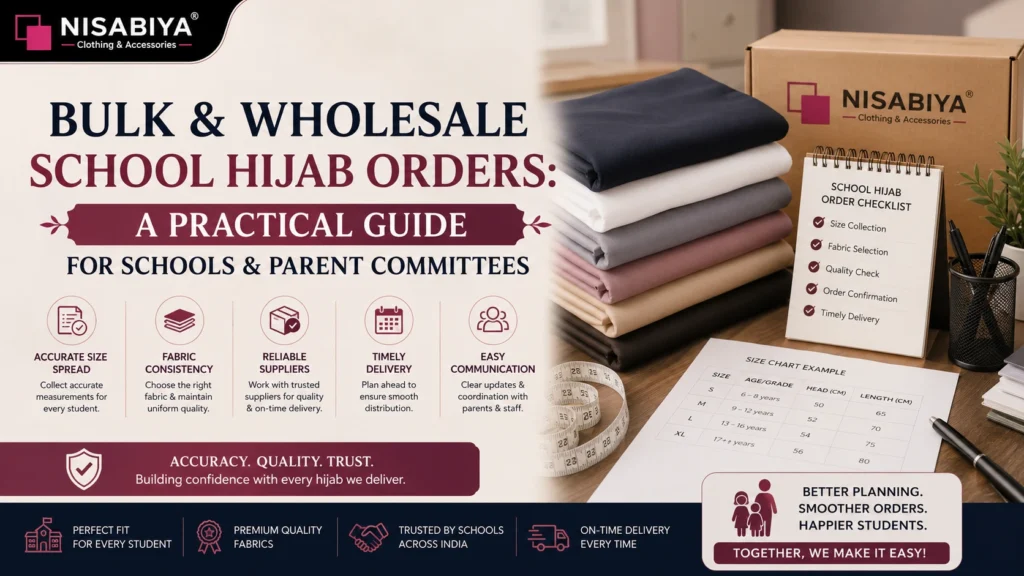
Wholesale School Hijab Orders: A Practical Guide for Schools & Parent Committees
Ordering hijabs for an entire class, grade or school? Here's what to sort out before you request a quote —…
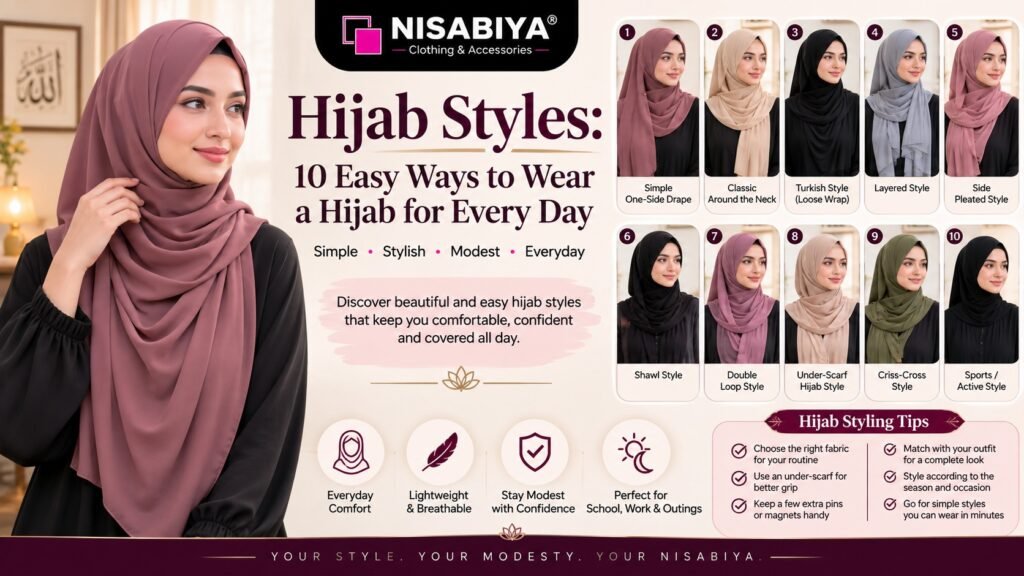
Read Article →There’s a specific, slightly familiar moment that leads most women to search for hijab styles: you own several nice scarves, you’ve been wrapping them the same way for months, and you want something that looks intentional without taking twenty minutes in the morning. The good news is that a handful of hijab looks cover almost every situation — school, work, weddings, hot days, windy days — and most take under two minutes once you know them. This guide walks through the styles we see our customers use most, with the practical details that actually keep a hijab in place all day.
If you’re choosing hijabs for a daughter, our parent’s guide to school hijabs covers sizing and fabric — this post is about the styling itself.
Every hijab style below relies on the same three fundamentals. First, fabric matters more than technique: cotton and jersey scarves grip better and stay put, while slippery georgette and silk-look fabrics need extra pinning or an under-scarf. Second, a lightweight under-scarf (or even a cotton cap) gives fabric something to grip and stops slip-back around the hairline — this single addition changes how well every style holds. Third, always keep a couple of extra pins or a magnet set in your bag; the styles that look most effortless are usually the ones that needed the most secure pinning.
Here are the hijab styles we recommend most, roughly ordered from easiest to most involved. None of them need anything beyond one scarf, pins and maybe an under-scarf.
Place the scarf over your head, let both ends fall to one side, and secure with one pin at the shoulder. It’s the fastest of all the looks here, stays neat, and works with virtually every face shape — the default for rushed mornings.
Pin the scarf under the chin, then sweep the longer end back over the opposite shoulder and secure it at the back. The asymmetric line softens the face and looks polished in minutes.
Bring both ends under the chin, cross them, and pin at the nape or side. Because everything is held below the face, this style is one of the most secure options for windy weather and active days — and a very common choice for school-age girls, which is why we recommend it in our school uniform guide too.
This is the fuller, rounded look popular across the Gulf. It needs a wider rectangular scarf and a bit more fabric at the sides — wrap loosely, arrange volume at the sides of the face, then pin under the chin and at the shoulder. It pairs beautifully with Gulf-style abayas.
Skip the under-chin fold entirely and wrap the scarf around the head, tucking the ends in at the back. Turbans are practical for sports, cooking or humid days, and they’re genuinely one of the most adaptable hijab options since nothing sits under the chin.
After the first wrap, cross the two ends over the top of the head once before pinning them at the back. The extra layer keeps the scarf anchored without making it look heavy, and it works especially well with lightweight summer fabrics that tend to slip.
For weddings and gatherings, let the back of the scarf fall long — past the shoulders toward the elbow — and add a decorative pin or brooch at the side of the head. This is the style our team most often pairs with embroidered occasion abayas.
Layer two scarves in contrasting colours — one pinned at the chin, one draped loose over it. The combination reads as deliberately styled while using scarves you already own, and it’s a good way to add colour to a plain abaya.
The under-chin wrap done precisely: no volume, ends tucked and pinned close to the neck, hairline fully covered. For uniform hijabs, this is the version that stays tidy from the first bell to the walk home — more detail in our school hijab guide.
Fold a large rectangular scarf lengthwise into a band, place it over the head so the fold sits at the hairline, and let the ends hang loose at the front. Minimal pinning, maximum comfort — ideal for prayer or relaxed weekends.
The styles above split neatly by setting. For school, the under-chin wrap and school-neat wrap hold best through PE class, lunch and outdoor play, and both work with the durable cotton and jersey fabrics we supply for school hijabs. For work, the side sweep and criss-cross look professional, stay put during a commute, and read as intentional rather than fussy — ideal with an office abaya.
If you wear a naqab, choose hijab wraps that pin firmly below the chin so the naqab has a stable base to sit on — the under-chin wrap and criss-cross are the two we recommend most. With an abaya, match the proportions instead of the colour: a voluminous wrap suits a flowing kaftan or butterfly cut, while a neat side sweep balances a tailored or structured abaya. Our naqab styles guide goes deeper on the pairing side.
Most women settle comfortably into four or five hijabs in rotation: two or three everyday cotton or jersey pieces in colours that match the wardrobe, one light georgette piece for summer and travel, and one dressier evening piece. That rotation gives a scarf time to air between wears — which keeps them fresher and cleaner far longer than owning one or two that get worn daily.
You don’t need to learn every hijab style on the internet — mastering just three or four hijab styles that hold all day will cover 95% of your mornings. Browse our school & everyday hijab collection, explore our naqab pairing guide if you wear one, or message our team on WhatsApp if you’d like fabric recommendations for the styles you’ve picked.
Loved this guide? Get styled by our team on WhatsApp — free advice, no obligation.
💬 Order Custom Abaya on WhatsApp
Ordering hijabs for an entire class, grade or school? Here's what to sort out before you request a quote —…
Read Article →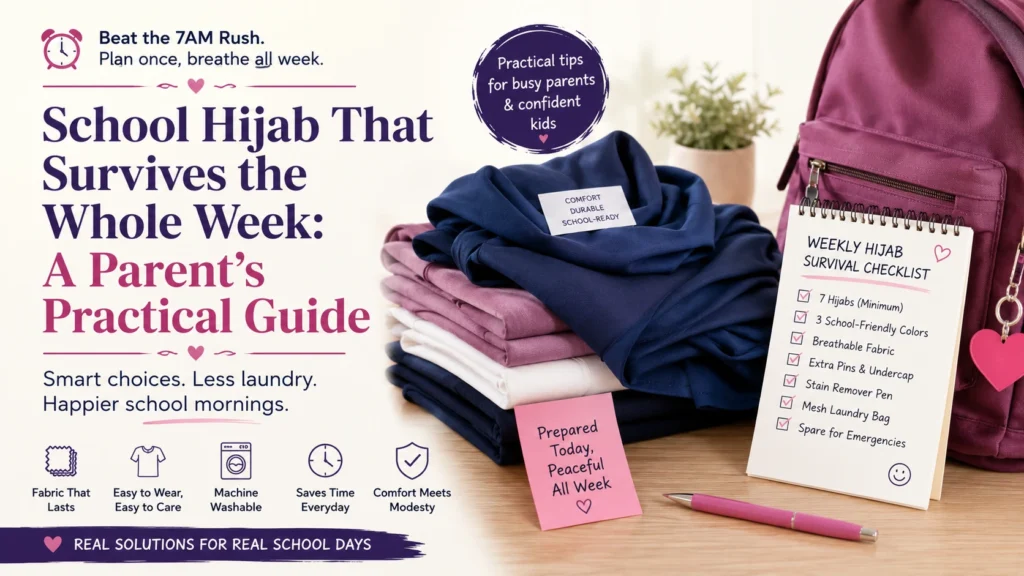
Choosing school hijabs that stay neat through PE class, lunch, and the walk home? Here's what actually holds up —…
Read Article →