Burqa vs Naqab vs Abaya: These three words get used almost interchangeably online, in shops, and even in casual conversation — and it causes genuine confusion, especially for people ordering for the first time or shopping for a family member with different needs. So let’s clear it up properly, garment by garment, in plain language.
The Short Answer First
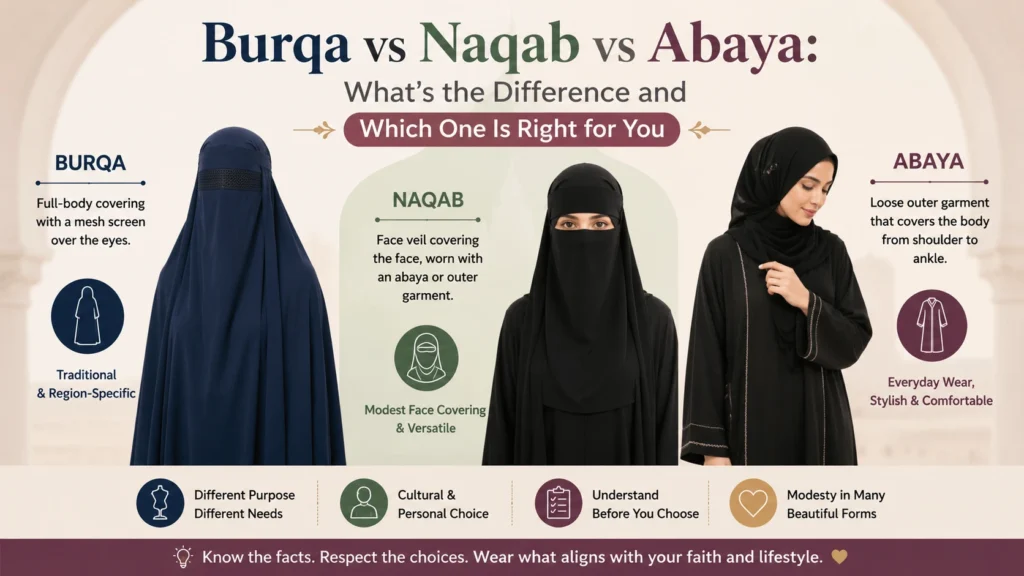
Abaya — a loose, flowing outer garment that covers the body from shoulders to ankles. It does not cover the face or hands.
Burqa — a full-body covering that includes a face covering as part of the garment, historically associated with certain regional styles, most commonly a one-piece design.
Naqab (Niqab) — specifically a face veil, usually worn separately alongside an abaya or other outer garment, leaving the eyes visible.
In other words: an abaya is the outer garment for the body. A naqab is the face covering, worn in addition to it. A burqa, in many regional traditions, combines both ideas into a single connected garment. The terms overlap in everyday speech partly because regional practice varies enormously across different countries and communities — there is no single “correct” style, only different traditions and personal preferences.
Abaya, in More Detail
The abaya is the most widely worn of the three. It’s a long, loose-fitting robe, typically opening down the front, worn over regular clothing. Necklines, sleeve styles, fabric, and embellishment vary hugely — from a completely plain black everyday abaya to heavily embroidered pieces for weddings and formal occasions. It says nothing, by itself, about whether the face is covered — that’s a separate, personal choice layered on top.
Naqab (Niqab), in More Detail
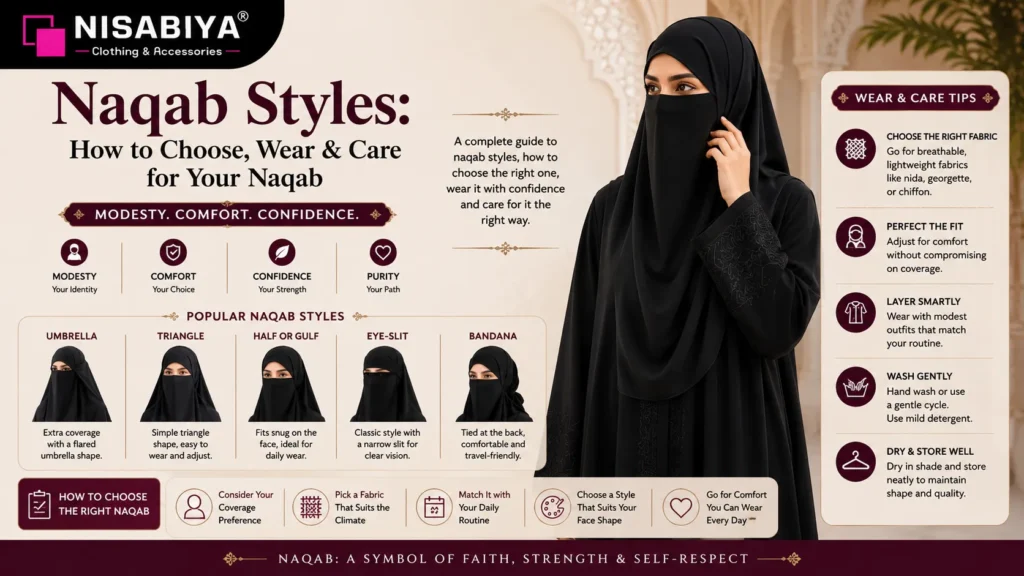
A naqab is a face veil, typically tied at the back of the head, that covers the lower face while leaving the eyes uncovered. Some styles include a second, sheer layer that can be worn over the eyes as well, which the wearer can flip up or down depending on the setting. Naqabs are usually chosen and fitted independently of the abaya — meaning you can pair the same naqab with several different abayas, or vice versa, based on the day’s occasion.
Fit matters more here than people expect. A naqab that’s cut too wide gaps at the sides and slips during the day; one that’s too narrow feels restrictive around the nose and mouth. We stitch naqabs to sit securely without pinching, in breathable fabric that doesn’t trap heat against the face — an important detail for anyone wearing one through a full working day.
The right naqab shouldn’t need constant adjusting. If you’re touching it every ten minutes, the fit — not the fabric — is usually the problem.
Burqa, in More Detail
“Burqa” is used differently across regions and communities, which is exactly why it causes confusion. In some traditions it refers to a single connected garment covering the body and face together, sometimes with a mesh or grille panel over the eyes rather than an open eye slit. In everyday South Asian retail use — including how many of our own customers use the word — “burqa” often simply means a full-coverage outer garment, structurally similar to an abaya, sometimes paired with an attached or separate face covering.
Because the word carries different meanings in different places, the most useful approach when ordering is to describe exactly what you want rather than relying on the label alone — for example, “a loose black outer robe with a separate tie-back face veil” gives us everything we need, regardless of which term you’d naturally reach for.
🧕
Custom Made
Burqa & Naqab, Stitched to Your Exact Preference
Tell us how you wear yours — we'll match the cut, fabric and coverage style
Rather than starting from the terminology, it’s usually easier to start from three practical questions:
Do you want to cover your face, or just your body? If it’s just the body, you’re looking at an abaya on its own. If you also want face coverage, you’ll need a naqab in addition, or a combined design.
Do you want the face covering permanently attached, or removable? A removable naqab gives you flexibility to wear it only in certain settings. An attached design is more secure but less adjustable through the day.
What’s the occasion? Daily wear favours breathable, low-maintenance fabric. Travel — especially for Umrah and Hajj — favours lightweight, easy-to-pack pieces. Formal occasions can carry more embellishment.
If you’re still unsure which word applies to what you’re picturing, that’s completely normal — just describe the garment to our team on WhatsApp and we’ll confirm the right cut before stitching anything.
A Note on Regional and Personal Variation
It’s worth saying plainly: there is no single correct way to dress modestly, and practices vary widely by country, community, and personal choice. What we’ve described above reflects common, general usage of these terms in the Indian market where we operate — not a religious ruling or a universal standard. If you’re new to any of these garments, the general background on face-veiling practices available online can be a helpful starting point for understanding the wider context, alongside speaking to people in your own community about what feels right for you.
Still not sure which one to order? Describe what you're picturing and we'll tell you exactly what to order — no pressure, just honest advice.
Yes, absolutely. Many customers order naqabs separately to pair with abayas they already own. Just send us your preferred fabric and tie-back style.
No — usage varies by region and community. We always confirm the exact style you want (attached face covering vs. separate, mesh vs. open eye area) before stitching.
Lightweight, breathable fabrics like cotton-blend or fine chiffon work best against the face. Avoid thick or synthetic fabric that traps heat — we can guide you to the right option on WhatsApp.
Yes, this is one of our most popular custom requests — a perfectly matched set stitched from the same fabric roll.
Order With Confidence
Whatever term you use, our team will always confirm the exact cut, coverage, and fabric before stitching — so there’s no risk of ordering the “wrong” thing. Browse our burqa & naqab collection, check our size guide if you haven’t measured yet, or just message us directly on WhatsApp with a description of what you need.