Abaya Size Guide – If you’ve ever ordered a “free size” abaya online and had it arrive either swimming past your ankles or straining across the shoulders, you already know the problem with guessing. A well-fitted abaya isn’t about vanity — it’s about being able to move, pray, walk, and sit comfortably in a garment that’s supposed to feel effortless, not restrictive.
The good news: getting an accurate fit doesn’t require a tailor visit. With a soft measuring tape, a friend, and about ten minutes, you can take the six measurements that matter most for a custom-stitched abaya — the same numbers our team asks for on WhatsApp before we cut any fabric.
Why “Free Size” Almost Never Actually Fits
Most mass-market abayas are cut for an “average” height of around 5’4″–5’5″ with average shoulder width. If you’re taller, shorter, broader, or narrower than that average — which describes most people — the garment compensates in the wrong places. Sleeves end up too short or comically long. The hem drags on the floor or stops mid-shin. The shoulder seam sits an inch off, which throws off how the entire silhouette hangs.
Custom stitching flips this logic: instead of you adjusting to the garment, the garment is built around your actual body. It’s the same principle behind bespoke tailoring anywhere in the world — the abaya has simply been under-served by ready-to-wear sizing for a long time.
A garment that fits doesn’t just look better in photos — it moves the way you move, all day, without you thinking about it.
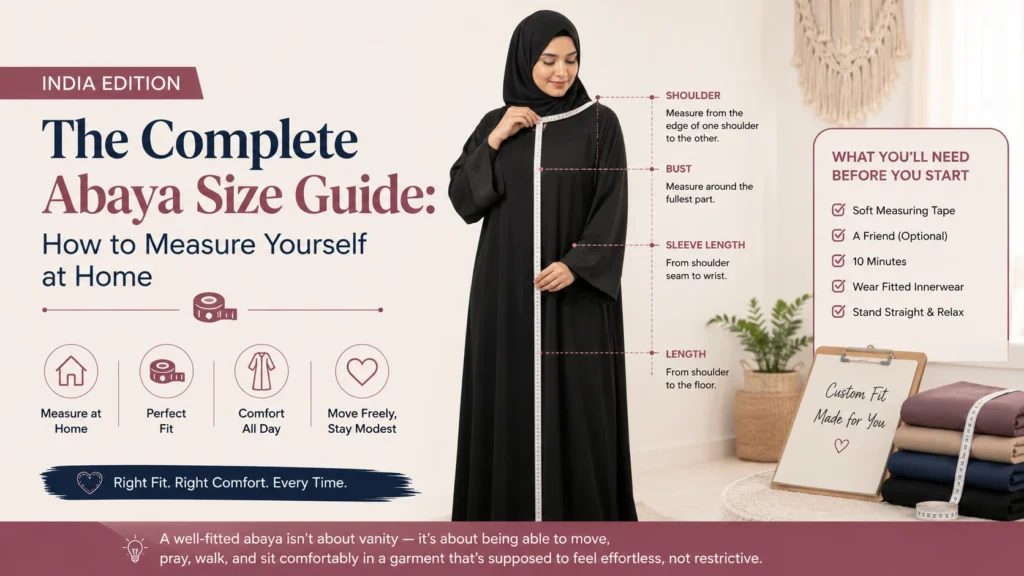
What You’ll Need Before You Start
A soft (cloth or vinyl) measuring tape — not a rigid metal one
A well-fitted top and bottom, or light clothing (avoid measuring over bulky layers)
A friend or family member to help with the back measurements (you can do most of it solo, but shoulder-to-shoulder is easier with help)
A notepad or your phone to jot down numbers as you go
The 6 Measurements We Actually Use
1. Full Length (Shoulder to Ankle/Floor)
Stand straight in the flat shoes or flat sandals you’d typically wear with an abaya. Measure from the highest point of your shoulder, straight down, to wherever you want the hem to sit — ankle-length, floor-length, or a slight drag for a more formal look. This single number has the biggest visual impact on fit, so take your time here.
2. Shoulder Width
Measure straight across your back from the edge of one shoulder to the edge of the other, where the sleeve seam would naturally sit. This determines how the abaya sits on your frame — too narrow and it pulls, too wide and the sleeves droop.
3. Bust/Chest Measurement
Wrap the tape around the fullest part of your chest, keeping it parallel to the floor. Don’t pull it tight — it should sit comfortably, the way the fabric will.
4. Waist Measurement
Measure around your natural waistline (usually just above your belly button, where your torso naturally bends side to side). Most abayas are cut loose through the waist, but this number helps us balance the drape correctly, especially for fitted or belted styles.
5. Sleeve Length
With your arm slightly bent, measure from the shoulder edge down to your wrist bone, or wherever you prefer your sleeve to end — full-length, three-quarter, or a looser bell cut.
6. Arm Circumference (Bicep)
Wrap the tape around the widest part of your upper arm. This matters more than people expect — a sleeve that’s too snug at the bicep is one of the most common complaints we hear, and it’s a five-second fix if we know the number upfront.
📏
Made To Your Measurements
Custom-Stitched Abaya, Cut Exactly to Your Size
Send us these 6 numbers on WhatsApp — no minimum order, no tailor visit
A few small errors account for almost every fit issue we troubleshoot on WhatsApp:
Measuring over thick clothing. This adds false inches everywhere. Measure over light clothing only.
Pulling the tape too tight. This is the most common one. The tape should sit snug but not compressed — imagine the fabric resting the same way.
Slouching while measuring length. Stand as you naturally would, not stretched taller than usual.
Guessing instead of measuring shoes. If you always wear a small heel, measure in it. A 1-inch heel changes your floor-length hem by a full inch.
What If I’m Ordering for Someone Else?
This comes up often around Ramadan and wedding season — people ordering a surprise custom abaya for their mother, sister, or daughter. If you can’t measure the person directly, the next best method is to lay one of their well-fitting existing garments flat and measure it directly (shoulder seam to shoulder seam, underarm to hem, etc.). Send us both sets of numbers if you have them — actual body measurements and a reference garment — and our team will cross-check for the most accurate cut.
Reading a Size Chart vs. Custom Stitching
Standard size charts (XS–XXL) are useful for a rough starting point, but they average out a huge range of body types into a handful of buckets. If your proportions fall between sizes — say, a smaller bust with a longer torso, which is extremely common — a size chart will always ask you to compromise on one or the other. Custom stitching removes that compromise entirely, which is why it’s become the default way we work with clients rather than the exception.
For reference on how modest outerwear is generally cut and layered, the modest fashion overview on Wikipedia is a decent primer if you’re new to the category and want to understand silhouette terminology like A-line, kaftan-cut, and closed-front styles — all of which we can stitch to your measurements.
Not sure about a measurement? Send us a quick photo or voice note on WhatsApp and we'll help you get it right — free sizing support, every order.
No. Custom sizing is included in every order at no additional cost — it's simply how we work. Standard S/M/L/XL is also available if you prefer.
Let us know as early as possible on WhatsApp. If we haven't started cutting yet, we can update the measurements at no charge.
Within half an inch is ideal, but don't stress over perfection — our stitching includes small seam allowances specifically to absorb minor variations.
Yes, for wholesale and school hijab bulk orders we can arrange a sample piece first. Ask our team on WhatsApp for details.
Ready to Get Started?
Take these six measurements, save them in your phone, and send them to us on WhatsApp whenever you’re ready to order. Browse our current abaya collection for inspiration, check out real styling ideas on our inspiration page, or just message us directly — we’re happy to guide you through your very first custom order.