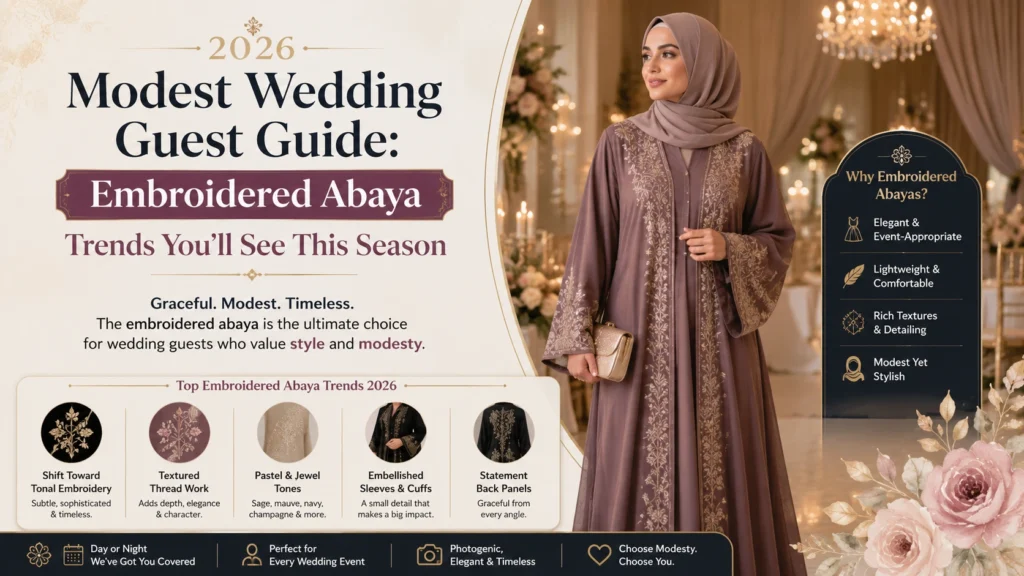
Bridal Abaya vs Wedding Guest Abaya: “Should this be as elaborate as a bridal piece, or is that too much for a guest?” is a question we get constantly during wedding season — and it’s a genuinely useful one to ask before you order, because the right amount of embroidery, the right fabric weight, and even the right color palette shift depending on your actual role at the event. This guide breaks it down by role, not just by trend.
For general seasonal styling direction, our wedding trends guide is a good companion piece to this one — that post covers what’s fashionable right now, this one covers what’s appropriate for your specific role.
If You’re the Bride
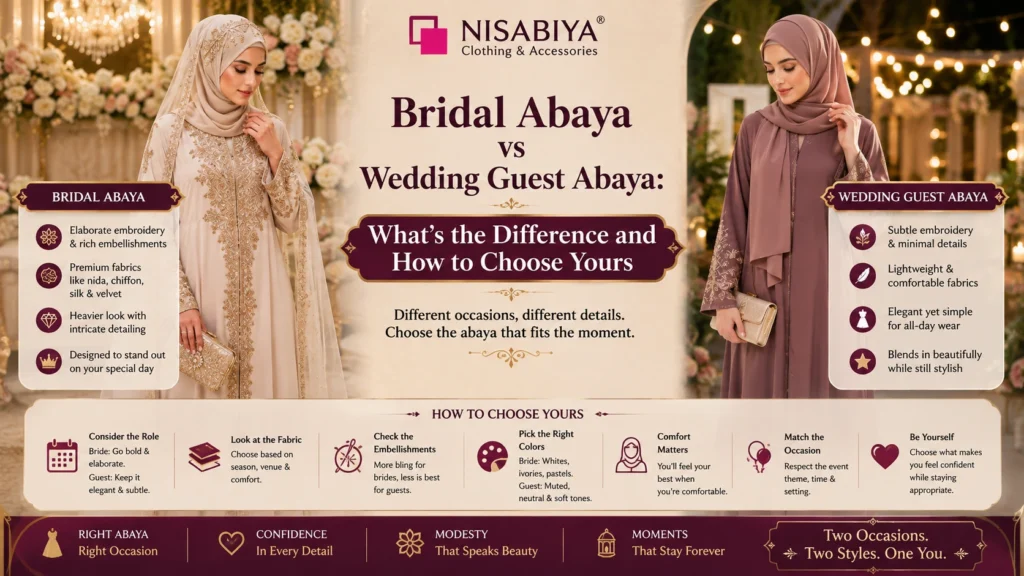
A bridal abaya genuinely earns the most elaborate embroidery you’re comfortable wearing — this is the one piece where dense, statement embellishment is expected rather than excessive. A few considerations specific to bridal orders:
Order significantly earlier than any other piece — bridal embroidery, especially hand-finished detailing, adds real production time, and fittings often need one or two rounds of adjustment. We recommend starting the conversation at least 6-8 weeks before the event.
Comfort still matters, even for the most elaborate piece — you’ll likely be standing, sitting, and posing for extended stretches in a bridal outfit, so a well-lined base fabric under heavy embroidery makes a real difference by hour four of the event.
Consider a going-away or reception change piece that’s lighter and less structured than the main ceremony outfit, since most brides find a second, more comfortable option genuinely useful for the later part of a long event.
The bride’s abaya is the one place where “too much” embroidery almost doesn’t exist — everywhere else, restraint usually looks better.
If You’re Close Family (Mother, Sister, Close Relative)
Close family members typically want something rich and celebratory, but distinctly secondary to the bride’s own outfit — a genuine balancing act. What tends to work well:
Rich color, moderate embroidery — a deep jewel-tone base with embroidery concentrated at the sleeves and neckline reads as festive and appropriately elevated without competing with the bridal piece.
Coordinate loosely with the wedding’s color palette if the couple has shared one, without matching it too literally — being in the same tonal family as the décor photographs beautifully without looking like you’re part of the bridal party specifically.
If multiple family members are ordering together, a shared fabric or embroidery style (even in different colors) creates a cohesive look in family photos without requiring identical outfits.
👰
Bridal & Occasion Wear
Custom Bridal & Family Wedding Abayas
From statement bridal pieces to coordinated family sets
This is where the “less is more” principle genuinely applies, both out of respect for the couple’s spotlight and for your own comfort through what’s often a very long event.
Tonal or subtle embroidery — embellishment in a shade close to the base fabric color reads as elegant without drawing attention away from the wedding party.
Prioritize comfortable fabric over maximum embroidery — as a guest, you’re less likely to be the center of photos for hours at a stretch, so a lighter, breathable base fabric usually serves you better than heavy detailing.
Avoid colors traditionally reserved for the bride in many South Asian and Gulf wedding customs (often specific reds or whites, depending on the couple’s cultural background) — when in doubt, a quick check with the host or a close family member avoids any awkwardness.
For broader cultural context on how wedding guest etiquette varies across different South Asian and Middle Eastern traditions, a general overview like the one on Wikipedia’s wedding customs page can be a useful, neutral starting point if you’re attending a wedding outside your own cultural background and want general context.
Fabric Choices by Role
Beyond embroidery density, the base fabric itself should shift slightly by role too:
Bridal: Premium crepe or nida as a structured base, often layered with a chiffon or tulle overlay for movement in photos.
Close family: Premium crepe alone usually strikes the right balance of richness and comfort for a long event.
Guest: Lightweight crepe or georgette, prioritizing comfort for what’s often several hours of standing, sitting, and socializing.
Budgeting Across Roles
It’s worth setting expectations honestly here — a bridal piece, given the embroidery density, fabric layering, and fitting rounds involved, typically costs meaningfully more than a guest piece, and reasonably more than a close-family piece. This isn’t arbitrary; it directly reflects the additional production time and materials. If you’re budgeting for multiple pieces across a multi-day wedding, planning this out by role in advance helps you allocate sensibly rather than overspending on an early function and running short for the main ceremony.
Color Etiquette Varies by Region and Community
One detail that trips up a lot of first-time wedding guests, especially those attending a wedding outside their own community for the first time: color expectations aren’t universal. What’s a perfectly safe guest color in one cultural context might be considered too close to bridal tradition in another. A few general patterns worth knowing, while recognizing these vary significantly by family and region:
Red is traditionally associated with the bride in many South Asian weddings, so guests often avoid deep, bridal-adjacent reds, opting instead for maroon, wine, or other red-adjacent tones that read as festive without overlapping.
White carries different associations across different communities and regions — in some traditions it’s considered inappropriate for guests, while in others it’s a completely normal, elegant choice. When genuinely unsure, a quick message to the host or a close family member is a simple way to avoid any awkwardness.
Gold and jewel tones (emerald, sapphire, amethyst) are broadly safe across most traditions and photograph beautifully in typical evening wedding lighting, making them a reliable default when you’re attending a wedding outside your own cultural background.
If you’re attending a multi-day wedding with different functions, it’s also worth checking whether each function has its own expected color palette — many South Asian weddings, for instance, lean toward brighter pastels for daytime mehendi functions and richer, darker jewel tones for the evening reception, a pattern also covered in our wedding trends guide.
Not sure what's appropriate for your role at the wedding? Tell us if you're the bride, family, or a guest, and the event type — we'll recommend the right level of embroidery and fabric.
It varies by embroidery density and fabric layering, but bridal pieces are generally 2-4 times the cost of a comparable guest piece, given the additional detailing, fitting rounds, and production time involved.
Yes, this is a common and effective approach — it creates visual cohesion in photos without requiring identical outfits, and we can coordinate this across multiple family orders.
It's generally best to keep guest embroidery more restrained out of respect for the couple, but for a genuinely close friend at a smaller, more casual function, moderate embroidery can be appropriate. When in doubt, tonal or subtle detailing is the safer choice.
The bride should start at least 6-8 weeks ahead given fitting rounds and embroidery time. Guests can typically order with 3 weeks' notice, though earlier is always safer during peak wedding season.
Order the Right Piece for Your Role
Knowing where you stand at the event — bride, family, or guest — makes every other decision about fabric, embroidery and budget much easier. Browse our bridal & wedding abaya collection, check current styling direction in our trends guide, or message our team with your role and event date to get personalized recommendations.
N
NISABIYA® Styling TeamCustom abaya, burqa, naqab & hijab specialists — Pan India delivery since 2018.
Loved this guide? Get styled by our team on WhatsApp — free advice, no obligation.